
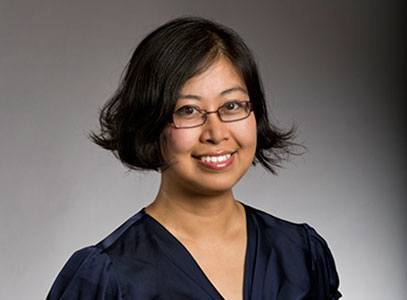
Linda Charmaraman
Senior Research Scientist
Director, Youth, Media & Wellbeing Research Lab
- Ph.D., University of California, Berkeley
- lcharmar@wellesley[dot]edu
- CV
Research interests include social media literacy, identity and agency development, wellbeing, digital citizenship, marginalized youth, and methodologies to target hard-to-reach populations
Linda Charmaraman is a senior research scientist at the Wellesley Centers for Women. She received her Ph.D. in Human Development and Education from UC Berkeley and is director of the Youth, Media & Wellbeing Research Lab, which she founded in 2018.
Charmaraman was co-author of the American Psychological Association’s 2023 advisory on adolescent social media use and 2025 advisory on the use . She provides expert advisory consulting for the Google Kids and Families team, Common Sense Media, and The Jed Foundation, among others. In 2023, she provided written testimony for the U.S. Senate Committee on the Judiciary hearing on Protecting Our Children Online.
Together with a youth advisory board, she co-organizes digital wellbeing workshops for middle school girls and allies from underserved backgrounds in the U.S. and beyond. Recent workshops have focused on topics voted on by youth themselves, including self-esteem and AI chatbots, emotional regulation, body image, community empowerment, AI literacy, parental monitoring of technology use, and the power of youth voice in their future digital ecosystems. You can follow her lab’s work on Instagram @youthmediawellbeing
Charmaraman’s longitudinal work on adolescent social technology use and parental media monitoring has been funded by the National Institutes of Health, Children and Screens: Institute of Digital Media and Child Development, and the Robert Wood Johnson Foundation, among others.
Charmaraman has published in over 60 peer-reviewed academic journals and book chapters, including Pediatrics, Journal of Adolescent Health, Journal of Adolescent Research, Computers in Human Behavior, Cultural Diversity and Ethnic Minority Psychology, and Journal of School Health. Mentions of her research have appeared in The New York Times, The Washington Post, NPR, Good Morning America, USA Today, ABC News, NBC News, Discover magazine, and The Conversation.
With seed funding from Children and Screens: Institute of Digital Media and Child Development, R15 funding from the National Institute of Child Health and Human Development (NICHD), and partnership with schools in the Northeast U.S., Charmaraman has been collecting longitudinal survey data about social technology use from adolescents in middle and high school and their parents/caregivers since 2019. Unexpectedly, this NICHD R15 study became a naturalistic examination of social media and wellbeing before and after the COVID-19 pandemic.
Charmaraman has continued to explore research questions related to influence of social contexts (e.g., home, school, online) on adolescent wellbeing with research collaborations with such institutions as Boston Children’s Hospital’s Digital Wellness Lab, Tufts University’s Pets and Well-Being Lab, and Brigham and Women’s Hospital/Harvard Medical School’s Developmental Risk and Cultural Resilience Laboratory.
The Youth, Media & Wellbeing Research Lab transforms its research into action for multiple stakeholders:
For tweens and teens, the lab has conducted virtual and/or in-person digital wellbeing workshops since 2019, reaching over 250 youth across 15 U.S. states, with attendees from as far away as Haiti, Brazil, and Hong Kong.
For college students, the lab provides leadership, innovation, and mentorship opportunities in several key areas of its work: research and dissemination, digital wellbeing workshop curricula design, program evaluation, peer mentoring, and website/social media management—all while igniting a passion for positive youth media development.
For parents and educators, the lab has conducted webinars, workshops, and community conversations with parents, schools and non-profit organizations in Massachusetts and across the U.S. For instance, the lab’s research was translated by Actively Learn, which has since created an 8th-11th grade curriculum on LGBTQ social media use accessed by over 5,000 users.
For policymakers, Charmaraman has conducted professional development for judges on social media and free speech, presented on a panel about girls growing up on social media to U.S. attorneys general, and advised on legislative language for U.S. senators regarding future government oversight and research collaborations with social media platforms. In 2023, she provided written testimony for the U.S. Senate Committee on the Judiciary hearing on Protecting Our Children Online.
For professional organizations and industry, Charmaraman has been invited as an advisory consultant and speaker for national organizations such as The Jed Foundation, the American Psychological Association, the Society for Research in Child Development, Common Sense Media, and the Center for Democracy & Technology. Additionally, she has provided expert advisory consultations to social media and tech companies to enhance their privacy, protection, and wellbeing programs for teen social media use.


